Bowie, Maryland
Standby Generator Installation in Bowie, MD
Standby Generator Installation in Bowie, Maryland, with published regional and national price ranges up front, your loads measured on site, and one written figure before any work begins.
Bowie, Maryland
Standby Generator Installation in Bowie, Maryland, with published regional and national price ranges up front, your loads measured on site, and one written figure before any work begins.
On a Pointer Ridge side street, a standby generator does its best work when nobody is thinking about it at all. The unit sits on its pad through quiet weeks, runs its brief exercise, and then, on the night a thunderstorm drops the BGE feeder, it starts on its own and carries the house until the grid comes back. We install standby generators across Bowie for homeowners who want that automatic response without cords, fuel cans, or a trip to the garage in the rain.
A standby system is different from a portable unit in kind, not just in size. It is permanently installed, connected to the home fuel supply and the panel, and paired with a transfer switch that handles the changeover in both directions. You do not wheel it out, and you do not have to be home for it to protect the house.
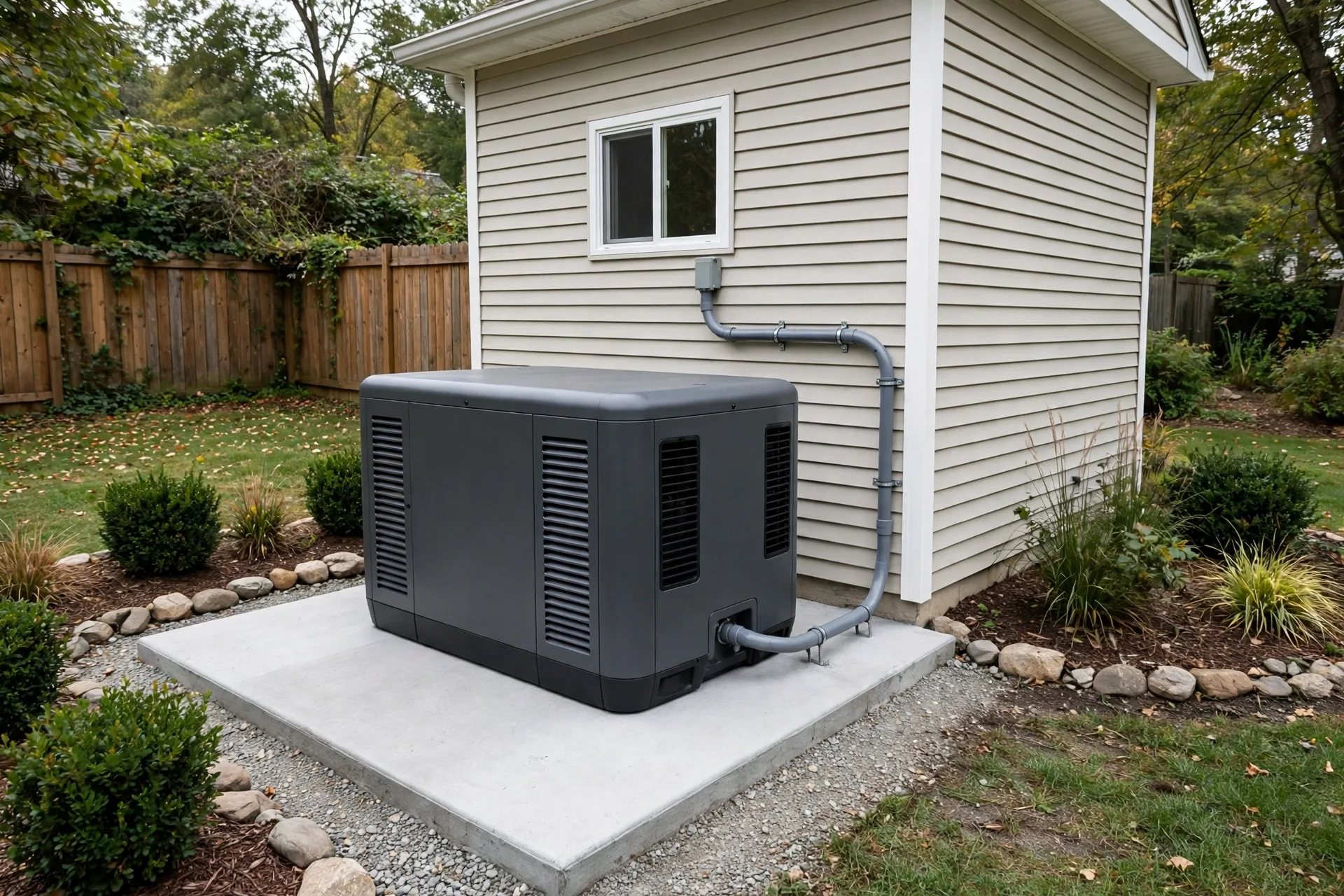
A standby generator is a fixed outdoor unit, much like a small cooling system in footprint, that watches the grid supply around the clock. When the transfer switch senses that grid power has failed, it signals the generator to start, then moves the house onto generator power once the unit is ready to carry load. When grid power returns and stays stable, the switch moves the house back, and the generator runs a short cool down before shutting off.
Standby units run on natural gas or propane in most Bowie installations, drawing from a supply already at the property or stored in a tank on site. That fuel link is why run time is measured in days rather than in the hours a small portable tank allows. Between outages, the unit exercises itself on a regular schedule, a short self test that keeps the battery charged and proves the system can start when called.
Sizing decides what the system carries. Some Bowie homes run a standby unit for the whole house, while others pair a mid size unit with a selected circuit panel covering the refrigerator, the air handler, a sump pump, key lights, and the outlets that matter most. We size from your panel and your appliance list, not from square footage alone.
Every installation starts with the quote form at the bottom of this page, followed by a site visit. At the visit we look at the panel and the load you want covered, the fuel supply and the run it will need, and the outdoor placement with proper clearances. Belair homes from the 1960s often need the panel looked at closely, since original services can be small and full.
Once the scope is set, we prepare the pad, set the unit, complete the fuel connection sized for full load, and wire the transfer equipment at the panel. Bowie addresses go through Prince George's County DPIE permitting for this kind of work, as the county process that applies to local installations, and that step is scheduled before the crew arrives to build. Power interruptions during the work are planned and kept short.
The last step proves the job. We simulate an outage with you there, watch the unit start and the house transfer, and run the assigned loads together. We check the exercise schedule, show you the indicator lights, and explain the basic upkeep the system needs.
A Pointer Ridge home needed automatic backup for the refrigerator, the sump pump, the air handler, and the main level lighting, with the unit kept off a patio the family uses most evenings. We placed the generator on the side elevation on a new pad, ran a direct fuel line from the meter, and balanced the selected circuits at a transfer panel beside the main panel. The system was exercised under its assigned load and left set for automatic operation.
No Bowie company publishes a full local price list, so the figures here are published regional and national figures, labeled as such, to help you plan. Published figures put turnkey standby packages at $9,500 to $30,000, covering the generator, the transfer switch, the pad, the fuel connection, and the electrical work as one installed system. Where a home lands inside that range depends mostly on the size of the unit and the scope of what it carries.
A smaller standby system covering selected circuits sits toward the lower part of the published range, while full house coverage with a larger unit sits higher. Fuel work moves the figure when the run is long, and panel work moves it when the panel has no room for the transfer equipment. Your firm figure comes from the site visit, where we measure load, fuel run, and placement at your property.
Bowie outages tend to arrive with weather, and weather here has range. Summer thunderstorms bring short, sharp cuts. Hurricane remnants and derecho winds bring longer ones, and winter ice can keep lines down while temperatures fall. A standby system is built for that whole range, because it asks nothing of the household in the moment. The freezer stays cold, the sump pump keeps cycling through the storm that caused the outage, and a medical outlet in a bedroom stays live through the night.
The housing stock adds to the fit. Bowie is a city where 83.9 percent of homes are owned by the people living in them, and owners invest in systems that protect the house as well as the people in it. A standby generator guards plumbing against freeze risk in winter and a finished basement against a failed sump pump in summer. Toward the edges of the city, where some properties rely on well systems, an outage also stops the water, which makes automatic backup even more practical. Choosing a scope comes down to your outage list: what must run, what should run, and what can wait.
Published regional and national figures put turnkey standby packages at $9,500 to $30,000 as one installed system. Selected circuit systems sit toward the lower end of that range and whole house systems toward the higher end. Unit size, fuel run length, and panel work set your place inside the range, and the site visit produces your firm figure.
Most Bowie standby installations run on natural gas where a gas service is already at the home, or on propane where a tank is on site or preferred. Both fuels suit automatic operation, and the right choice depends on what your property already has and how many days of coverage you want stored.
A residential standby unit produces a steady mechanical sound, broadly in the range of outdoor cooling equipment, and placement shapes how much of it the house and the neighbors notice. We place units with clearance and orientation in mind. The weekly exercise run is brief.
The system handles the outage without you. The transfer switch senses the failure, the generator starts, and the house runs on generator power until the grid returns and the system transfers back. That is the central advantage of a standby installation over a portable unit, which needs someone home to set it up and connect it.
The unit needs a level, stable base rated for its weight, which is commonly a concrete pad or a prepared base suited to the unit. We include the base work in the installation scope and choose the approach that fits your placement and soil.
Send the quote form at the bottom of this page with your name, the service you need, and a short message about your home and your outage list. We follow up with questions, then schedule a site visit to measure load, fuel, and placement.
Tell us about your home and what needs to stay on when the power goes out. We read every request that comes in and respond with the published range for that kind of work and the next step, starting with a visit to measure your load, fuel, and placement.
Prefer to talk it through first? Send the form and we will call you back at the number you give us.